Slavery did exist here, both Africans and Indigenous peoples were enslaved. Written records online can be difficult to find though paper trails exist throughout the 6 states. Below are some statistics.
Connecticut
- Hartford, 1639, 1st written record of enslaved individuals
- 1774, importation of enslaved individuals was banned
- 1784, gradual emancipation
- 1840, 54 enslaved individuals
- 1848, slavery abolished
Rhode Island
- 2nd largest number of enslaved individuals
- Newport & Bristol become leaders in the slave trade
- 1784 law called for gradual emancipation
- Trade was declared illegal 1808
- Still enslaved individuals counted in 1840
Vermont
- 1777, abolished slavery as it became a separate state
- This did not include enslaved individuals already living there
New Hampshire
- 1645, earliest record of enslaved individuals
- 1779, petition for freedom not signed until 2013
- 1840, still enslaved individuals
- 13th Amendment passed in 1865
Maine
- Part of Massachusetts until 1820
- Enslaved individuals in Portsmouth, Kittery, York
- Still had enslaved individuals as late as 1828
Massachusetts
- Presence of African enslaved peoples first recorded between 1624-29
- Pequot War fueled the slave trade by exchanging captured Pequots for Africans held in Barbados and other islands.
- Boston merchants controlled the American portion of what’s now called the Triangular Trade, a historical trading system between three regions – Europe, Africa, and the Americas – for most of the 17th century.
- Slavery not officially abolished until 1865 & the 13th Amendment
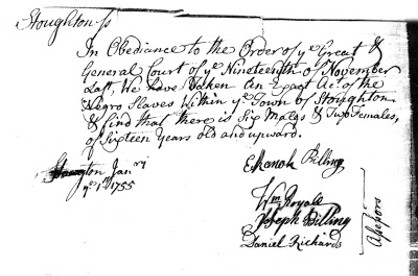
1754 Slave Census in Massachusetts
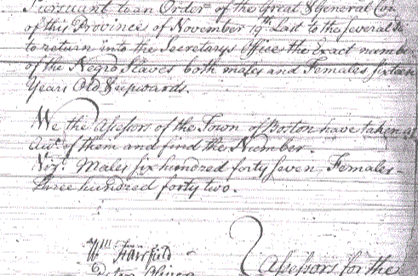
In 1754, Governor William Shirley had ordered that an enumeration of all enslaved individuals, both male and female, over the age of sixteen be completed by each town. This included Maine since it was still part of Massachusetts. 2720 enslaved individuals age 16 and above were counted (or about 4500 with children). This was 36 years before the 1790 census revealed no slaves. That is the popular statistic but careful examination of the 1790 and subsequent censuses show that people were still enslaved after the 1790 census.
Aquene, Cher
 Cheryll Toney Holley