Doctress is a term once used for a female doctor. It was more commonly used when females were not encouraged to practice medicine. It was also used to describe African and Indigenous women who used their cultures’ healing methods within (and sometimes outside) their communities.
A root doctress is a practitioner of African American folk medicine and spiritual practices. In Africa, medical practices tied together physical and spiritual healing. Traditionally and especially in the 17-19th centuries, root doctresses used various plants, roots, and other materials to create remedies for physical and spiritual ailments. They also performed rituals to provide protection, success, and other desired outcomes. The use of charms and amulets is also common in root work. Enslaved African women (and men) brought with them the medical and spiritual practices of their homelands. Plants and roots were different in what became America, but root workers had enough knowledge to seek out similar or related plants. By trial and sometimes error, individuals were able to create new medicines for use on this side of the Atlantic.
Historically, root doctresses had a reputation for the ability to cure conditions that western medicine could not. They were also able to treat members of their own communities when white doctors would not. Root doctresses were and are an important part of African American culture. Despite obstacles, including enslavement and persecution, root doctresses continue to practice and, more importantly, pass the knowledge on to subsequent generations.
For millennia, Indigenous women in what is now called the United States used plant medicine for healing. Plants were also used in spiritual practices by the community. When the English, Dutch, and French conquered this land, many Indigenous healing practices were demeaned by those that believed that European practices were superior. Nevertheless, Indigenous women continued to practice their medicines and deliver care to their communities. And do so to this day.
In the 19th century, there was a sudden influx in popularity of the “Indian Doctress.” In crowded urban areas where newspapers existed, ads proclaiming cures for various ailments by the local Indian Doctress abounded. It is unknown how many of these women were from tribal communities, but at least one in Massachusetts was.
This story briefly describes the lives of Susan Toney, Root Doctress, and her daughter, Lucy Proper, Indian Doctress. Mother and daughter practiced medicine in the early to mid-nineteenth century. They were Narragansett and Black women, born free to free parents – and my kin.
As Narragansett and Black women, Susan and Lucy played important roles in preserving their respective cultural healing practices. They carried forward the knowledge and traditions passed down to them by their ancestors, ensuring the continuity of African American folk medicine and Indigenous healing practices despite the challenges they faced. Their dedication to preserving their cultural heritage helped maintain a connection to their roots and provided a sense of identity and empowerment within their communities.
Susanna Toney Proper Van Rensselaer
Susanna Toney, better known as Susan or Sukey, was born in Barre, MA in 1789 to Abraham Toney, a free Black man, and Mary Harry, a Narragansett/Niantic woman. Mary died when Susan was a toddler and Abraham married again in 1791 to Hannah Chase, a woman born in Africa and once enslaved.
Abraham was a farmer and with his brother Caesar, Jr. traveled to Royalston, MA where they purchased one hundred acres of farmland. Susan grew up in Royalston, learning about plant medicines from her stepmother Hannah. Susan married Samuel Proper and settled in Rutland, MA where she continued to farm and practice root work on land that she and Samuel owned. Unfortunately, Samuel died early, and Susan remarried Joseph Van Rensselaer from Albany, New York. By 1830, the Van Rensselaers had purchased land in Worcester. Susan worked as a Root Doctress while living in Worcester. She maintained a listing in the yearly Worcester City directory. Her land was on Summer St Court near Bridge St and kept in her name. Her daughter, Lucy, owned the land adjacent to Susan’s. Susan died on 28 May 1847. Her son Joseph died in 1848, and husband, Joseph, in 1857
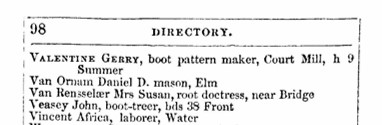
Susan was a landowner, an entrepreneur, a healer, wife, and a mother during a time that was cruel to people of color and women. Despite her healing skills, Susan, her husband, and all but one of her children died by 1857. Her daughter, Lucy, survived lung fever, or pneumonia, which brought down her family.
Lucy Proper Schuyler Thompson
Lucy’s parents were Susan and Samuel Proper. We believe that Lucy learned her plant medicines from her mother who learned from Hannah. Shortly after the family moved to Worcester, Lucy married Peter Schuyler, an itinerant preacher from the AME church who like Lucy’s stepfather, was also from Albany, NY. They had at least seven children together. Peter became a doctor like his wife Lucy while still in Worcester. It is unknown how this came about – Lucy and Peter both trained with Susan or Peter picked up his skills from Lucy. Peter might have acquired the skills of a healer from his formerly enslaved community in NY.
Around 1855, Lucy and Peter sold the land that they owned in Worcester and with their two surviving children, moved to Lawrence on the Merrimack River. Once in Lawrence, Peter and Lucy practiced medicine. Peter died less than a year after arriving in Lawrence. Lucy continued to practice medicine as an “Indian Doctress” on her own. In 1860, she married self-emancipated George Brown who changed his name to John G. Thompson to evade slave catchers.

In 1863, Lucy’s last surviving child, Arthur, lied about his age (15) and enlisted in the 54th MA Infantry. After two years, he returned home suffering from tuberculosis and died in April 1866. Despite losing her entire family, she continued to work as a healer. Perhaps due to her husband’s life, Lucy also became a conductor on the underground railroad. She is credited with writing at least two “slave narratives” and instigating a court proceeding to legally free an enslaved woman visiting Lawrence with her owners.
Lucy was 68 years old when she died in 1881. Her husband died a year later.
Susan Toney and Lucy Proper were healers within their communities and actively contributed to the overall health and well-being of the people around them. They provided medical care and remedies that effectively treated various ailments, often when conventional Western medicine fell short. Their services were particularly crucial for marginalized groups with limited healthcare access during that time. Susan and Lucy’s lives exemplify resilience despite multiple hardships. Living during a period marked by racial discrimination and limited opportunities for women, they overcame significant obstacles to pursue their passions and provide care for their communities. Despite losing their family members, they continued their healing practices, demonstrating their unwavering commitment to their calling and the well-being of others.
Their lives exemplify the intersectionality of their identities as Black and Indigenous women. Their experiences and contributions highlight the complex intertwining of race, gender, and cultural heritage. By acknowledging their intersecting identities, we gain a deeper understanding of the challenges they faced and the unique perspectives they brought to their healing practices.
The legacies of Susan Toney and Lucy Proper extend beyond their lifetimes. Their dedication to healing and preserving traditional practices left a lasting impact on subsequent generations. The knowledge they imparted continues to be passed down and valued within the local Black and Nipmuc/Narragansett communities, serving as a source of inspiration for aspiring healers and cultural preservationists today.
 Cheryll Toney Holley